Summary
In 2010, Roger Ebert wrote a famous essay in which he declared thatvideo games could never be art. Games are, in today’s world, primarily viewed as products designed to draw quarters (or, by today’s standards, $70 plus DLC), a notion that could convincingly move critics to the position that they are mere products, toys, or novelties. However, a prospective filmgoer back in 1878 who had only ever seen Eadweard Muybridge’sThe Horse in Motionmight be inclined to condemn cinema the same way Ebert did of video games. Like movies or the product of any other artistic discipline, games have had their fair share of trial runs or all-out empty vessels.
The several decades of being almost exclusively marketed to hormonal young boys certainly haven’t helped their legitimacy in the eyes of critics and academics, to say the least. However, despite lacking an institution to canonize them and despitebeing subjected to ever-increasing overfinancializationat the cost of creative freedom, great works in the medium persist nonetheless. A true work of high art, light or dark, absurd or straight-faced, punctures beyond the gossamer of the ordinary and speaks directly to its finder’s soul, transporting its holder into a spiritual plenum, a vantage from which to snatch life’s true meaning, perhaps even moving them enough to change their mind.
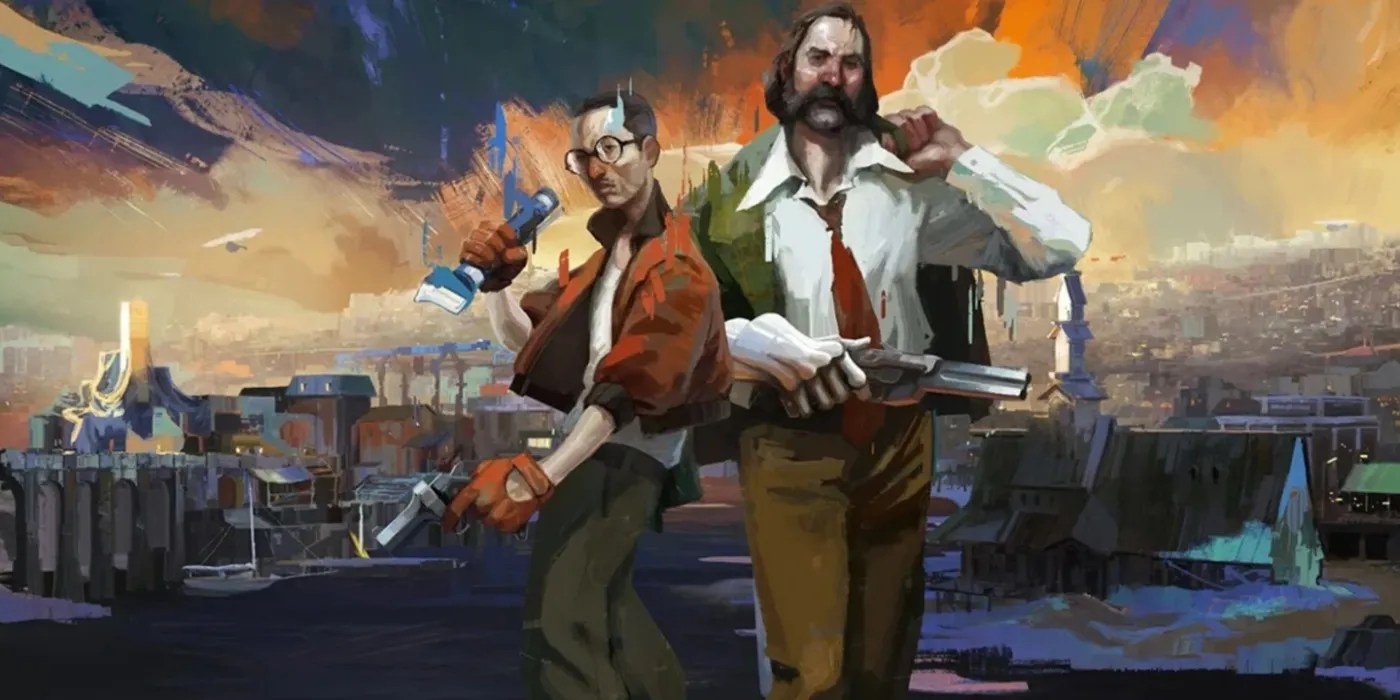
A poet might say that art can be found anywhere in nature, in the human world, even in nothingness.Disco Elysiumis not a game that can be interpreted as art, nor was it found that way; it was built from the ground up as such, and by ZA-UM, a bonafide art collective, no less. A work of art’s legitimacy does not necessarily stem from its author’s credentials, but in this case, the work speaks volumes about its masteries. Even with its mesmerizing oil-painterly art style, music and sound design, andstunningly frank, darkly sublime writing,DEis more than the sum of its parts. It crosses fearlessly from the political to the existential without its profundity overstaying its welcome for a moment, thanks to an expertly measured amount of self-awareness, humor, and a strictly high bar for quality.
ZA/UM expertly took elements of the role-playing game genre and used them to draw up the absurdity of living as a human animal under incomprehensibly vaster cosmic and economic forces. Few games have managed to maturely explore the territory of the human mind and mental illness quite as well asDisco Elysium. Despite all this, it is an immediately accessible game, complete with all the gameplay mechanics expected of a classical RPG (minus the combat system). The outcome of skill checks is never “win or lose,” just as each character in Revachol (including the protagonist) is not overlooked for their personal, economic, or situational shortcomings. On the contrary, their characterizations are able to speak directly to the player’s own lived experiences, existential fears, and secret hopes.

Kill or be killed is just about the easiest feature to code in video games, and it’s the driving throughline through practically every popular title on digital storefronts these days. However, rather than dedicating half a decade’s worth of production time to creating the most visceral, money-making eye candy for some twitchy trigger time fun, some developers have chosen to use their tools to promote empathy. This gameis a stellar example of a game that leverages its mechanics to do so in a “play-don’t-tell” manner. InPapers, Please,players find themselves in the unusual role of an immigration inspector at the border of a country.
Rather than simply assuming this role as the usual disembodied hand and camera, they have several resources to manage, ranging from the hunger of their family to the stability and security of their country. Watching someoneexperience a moral dilemmais much different from experiencing one, albeit simulated, andPapers, Pleaseproves this from the very moment the game starts until the end by throwing crisis after compelling crisis on the player’s desk. Although many critics have said that video games are responsible for desensitization thanks to their typically violent gameplay loops and high levels of graphical realism, a whole movement has arisen around promoting empathy through gameplay sincePapers, Please’s release.

By most metrics,Shadow of the Colossusis a very traditional game. There is a storyline, bosses, health mechanics, and an ending. The game is captivatingly beautiful, but it would be hard to argue that no other title has matched its fidelity, especially in recent years. It may not have created a new genre or become self-aware, but it is one of the most concise examples of how a combination of tightly focused gameplay and player input can produce a transcendent experience impossible to find in other mediums, infused with notes of terror, triumph, dedication, and guilt, to name but a few.
Of course, many games achieve the same effect, but none are quite as streamlined and focused asShadow of the Colossus. Those skeptical of non-linear games due to their “loss of authorship,” or those who demand any artwork to prove an artist’s “intention” may at least compromise with a game so stripped back, awaiting only the secondary author, the player, to deliver the inputs to bring it to its sobering completion. The beauty of this contender as a work of art is that it proves that while video games can beinfinitely creative and mechanically surprising, they are fully capable of achieving masterwork status even on their own most basic terms.

Just as with plays, novels, and cinema, all art disciplines go through a transition into self-awareness and deconstruction. This marks the moment of maturity, when it begins to recognize its own language and history, breaking them down in a fit of self-awareness. No other game demonstrates this feature quite likeUndertale, which appears on the surface to be aloving homage to 16-bit eragames of the past. However, those who have experienced it from start to finish to its “true end” will understand that the relationship between player and game is more than parodied, examined, or mastered (although it does all three).
Undertaildisarmingly challenges a player’s notion of game grammar in its questioning of violence, but more, it masterfully evokes profound doubts in the player’s mind about their expectations of “choices.” Other “artful” games have tackled the concept, but Undertale creator Toby Fox somehow managed to use the medium itself to break the player’s inherenttime-traveling, save-loading powersto dramatic and striking effect. Once the player reaches a certain point in the branching story, they may find themselves reaching to peep back to “consume” more “content,” but they may findUndertaleitself staring back.

Some games are said to be interactive forms of art. While some titles offer such visual spectacle that they would handily fall into the category in their own right purely from a painterly perspective, others borrow so heavily from other disciplines like cinema that they end up beingmore like “playable movies"that would no doubt garner encouragement from film or critics who snub video games as toys. However, critics rating a game on its visuals or cinematography alone somewhat fail to grasp what the spiritual core of the video game really is: agency in play. Visually crunchy games likeDwarf Fortressdemonstrate its artfulness in its lines of code.
Video game skeptic Roger Ebert said in his critique of the medium, “One obvious difference between art and games is that you’re able to win a game.” AsDwarf Fortresswas designed to be more of a universe simulator, the game can’t technically be won or lost, only experienced as a complete cosmos in and of itself (or as complete as one can be on a contemporary computer). There is no middle, beginning, or end. There are richly simulated Dwarves and the richly interconnected world around them that, in tandem, reflect a pure act of creation. While they come with limits (as any work does),Dwarf Fortressand its first-person cousin have punched holes in the possible.
Special mentions:Minecraft,Infiniminer
